












Curriculum
The curriculum is reflective of a program of graduate education that provides for intense and analytic exploration of the basic medical sciences, clinical anesthesiology, professional practice, technological applications and research methodology. The Program is designed as a continuous (no semester breaks) and sequential program spanning approximately two and one half years and totaling 51-semester credit hours. Affiliated clinical sites are located throughout the State of Florida. Nurse Anesthetist Residents are assigned to an affiliated clinical training site at the start of the program. Clinical instruction is incorporated through progressive practica throughout all seven semesters. Clinical practica consist of in-service education presentations, morbidity and mortality case conferences, clinical instruction and supervised clinical practice. Course sequencing is critical to the educational program. Therefore, certain didactic courses and clinical practica must be satisfactorily completed in sequence.
An optional part-time Pre-Start Plan is available for students who wish to begin the program early to lighten their course load (see the Degree Plan page for details).
The Program consists of an intense academic didactic curriculum with a comprehensive clinical component modeled as a residency and offered at premier health care facilities throughout the state of Florida . Entering into this rigorous Program is a major undertaking - it is designed only for those capable and autonomous critical care nurses that are highly motivated, strong in the sciences and willing to commit to life-long learning and professional activism.
This graduate level Program is designed as a full-time, continuous (no semester breaks) and sequential program spanning approximately two and one half years (28 months) and totaling 51-semester hours. Students receive over 760 hours of didactic instruction and over 3,500 hours of clinical instruction. The Program is accredited by the Council on Accreditation of Nurse Anesthesia Educational Programs, 222 South Prospect Avenue Suite 304 , Park Ridge , IL 60068 , (847)692-7050 through 2010. Upon successful completion of the curriculum, graduates are eligible to sit for the National Certification Examination for nurse anesthetists and are eligible for licensure as an advanced practice professional nurse by the State Boards of Nursing in the state in which the graduate seeks to practice. Upon completion of certification and licensure requirements, graduates attain the professional credentials of Certified Registered Nurse Anesthetist (CRNA) and Advanced Registered Nurse Practitioner (ARNP in Florida or similar terminology used in other states).
The curriculum is reflective of a program of graduate education that provides for intense and analytic exploration of the basic medical sciences, clinical anesthesiology, professional practice, technology and research methodology. Leadership development is fostered through mentoring and professional activities; cultural competence, caring and a global perspective of health care are stressed.
The curriculum is designed to emphasize didactic instruction in the first year with progressive clinical experiences and to emphasize clinical instruction the second year and a half with integrated didactics. At the completion of the first semester (approximately 15 weeks), students transition to their assigned clinical region. The remaining didactic coursework is taught by faculty from all over the state using live, interactive video teleconferencing. While a professor may be in Tampa , you can learn live from Miami and converse "real time" with him or her!
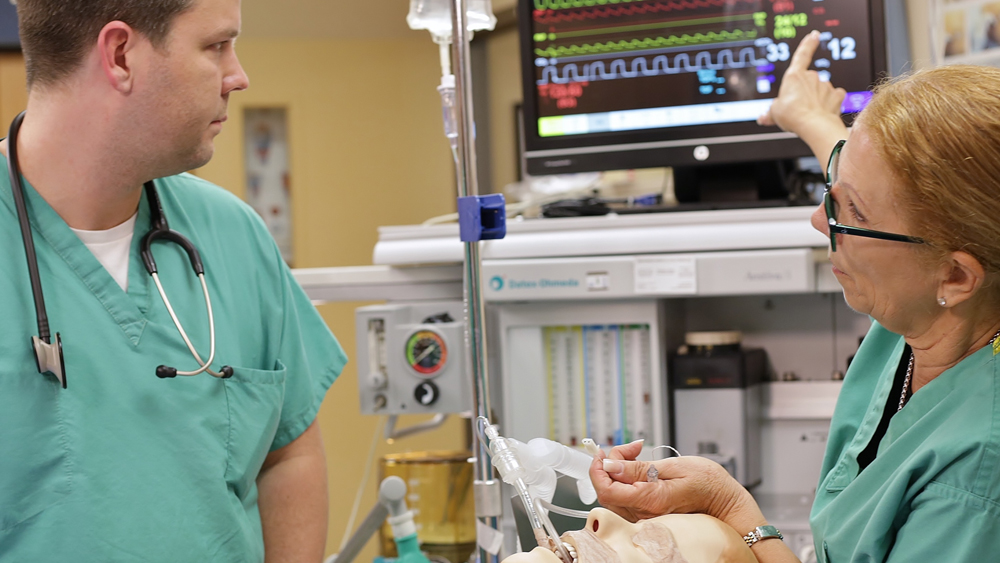
Expert nurse anesthetists, physician anesthesiologists and surgeons serve as clinical faculty and provide Barry University student residents with over 3,500 hours of clinical instruction in the art and science of anesthesiology. Affiliated clinical sites are located throughout the State of Florida . Nurse Anesthetist Residents are assigned to an affiliated clinical training region at the start of the program. Clinical instruction is incorporated through progressive experiences throughout all seven semesters.
Student residents learn all clinical anesthesia specialties, including cardiothoracic and vascular, neurosurgery, obstetrics and pediatrics, trauma, gynecologic and genitorurinary, head and neck, plastics, pain management and office-based and ambulatory care. In addition, student residents learn both general and regional anesthetics and critical care procedures. The ratio of students to faculty is 1:1 or 2:1, depending on the complexity of the case and the level of the resident. Course sequencing is critical to the educational program. Therefore, certain didactic courses and clinical practica must be satisfactorily completed in sequence. Nurse Anesthetist Residents average just over 60 hours per week of committed time devoted to didactics, clinical training and study time.
Important Notice: Participation in clinical experiences, rotations or fieldwork is a required part of the curriculum and a requirement for graduation. Clinical rotation and fieldwork sites may require a drug, criminal, and/or child abuse background check in order to permit participation in the program's clinical experience, rotation or fieldwork. Clinical rotation and fieldwork sites may deny a student's participation in the clinical experience, rotation or fieldwork because of a felony or misdemeanor conviction, failure of a required drug test, or inability to produce an appropriate health clearance, which would result in delayed graduation or in the inability to graduate from the program. Individuals who have been convicted of a felony or misdemeanor may be denied certification or licensure as a health professional. Information regarding individual eligibility may be obtained from the appropriate credentialing bodies. Drug and background checks will be done at the student's expense. |
|