








• Create admissions profile
  • Check on application status
Admissions
Connect with us

Chemistry Course Descriptions

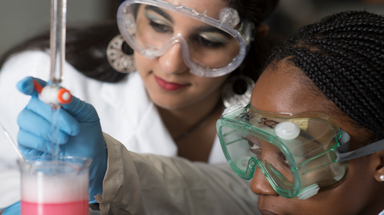
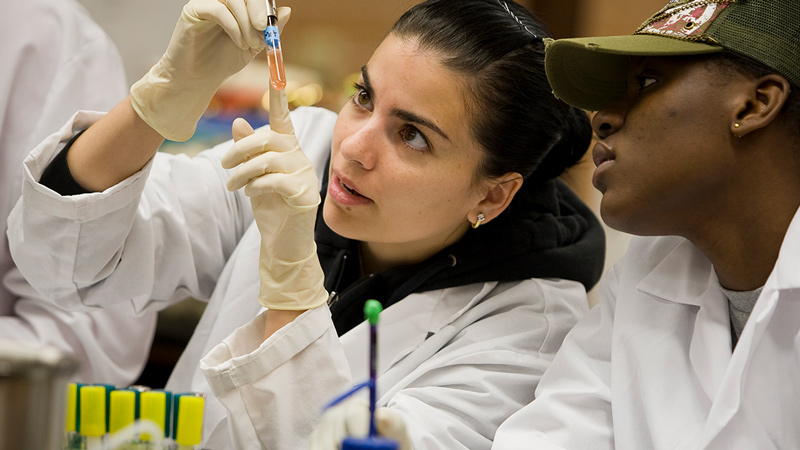
Cherice Boyce (Class of 2010) conducts an experiment to determine the level of capsaicin in peppers.

095 Preparation for College Chemistry (3)

Preliminary course for students who wish to complete a major or minor sequence in chemistry but do not meet requirements for admission to Chemistry 111 or CHE 152; given on CR/NC option only; credit not applicable toward graduation, major, or minor. Prerequisite: Mathematics placement in MAT 093 or higher. (Fall, Spring)

111 General Chemistry and Qualitative Analysis I (3)

Chemical principles and descriptive inorganic chemistry for students majoring in chemistry, other sciences and mathematics. Topics include; nomenclature, stoichiometry, aqueous reactions, gases, quantum description of the atom, periodic trends, Lewis structures, molecular shapes, thermochemistry and nuclear chemistry. Prerequisite: Math 095 or higher and CHE 095 or score of 16 or higher in chemistry placement exam. Co-requisites CHE 111L and SI 071. Must take lecture and SI with the same section number. (Fall, Spring, Summer)

111L General Chemistry and Qualitative Analysis I Lab (1)

Laboratory course taken concurrently with CHE 111. Topics include: nomenclature, stoichiometry, inorganic synthesis, gases, atomic spectra, periodic trends, thermochemistry, and nuclear chemistry. (Fall Spring, Summer) (Special Fee).

112 General Chemistry and Qualitative Analysis II (3)

Chemical principles and descriptive inorganic chemistry for students majoring in chemistry, other sciences, and mathematics. Topics include: kinetics, equilibrium, acid/base, solubility product, thermodynamics, oxidation/reduction, liquids, solids, intermolecular forces, and coordination/transition element chemistry. Prerequisite: grade of C or better in CHE 111 and CHE 111L and mathematics placement in MAT 109 or higher. Co-requisites: CHE 112L and SI 072. Must take lecture and SI with same section number.(Spring, Summer)

112L General Chemistry and Qualitative Analysis II Laboratory (1)

Laboratory course taken concurrently with CHE 112. Topics include: kinetics, equilibrium, LeChatelier's principle, acid/base titration, solubility product, thermodynamics, electrochemistry, structural determination of organic compounds, coordination chemistry, and qualitative ion analysis. (Spring, Summer) (Special Fee).

135, 135L Consumer Chemistry (4)

Introductory chemistry course with emphasis on chemical concepts and applications to understanding the world around us. Laboratory exercises are performed to reinforce chemical concepts discussed in lecture. This course is intended for non-science majors who wish to fulfill the science general education requirement. 2 hours lecture, 2 hours laboratory weekly. (Spring) (Special fee)

152, 152L Introduction to Organic and Biological Chemistry (3) (1)

Organic chemistry with application to the chemistry of the cell. 3 hours lecture, 2 hours laboratory weekly, to be taken concurrently. Co-requisite SI 073. Must take lecture and SI with same section number.This course is intended for students in the nursing, occupational therapy, anesthesia technology, cardiovascular perfusion programs, and sports medicine majors. Prerequisite: High school chemistry within the last 3-4 years or consent of instructor, or CHE 095. (Special fee) (Fall, Spring, Summer)

209, 209L Environmental Perspectives in Chemistry (3)

An examination of environmental problems emphasizing chemical aspects of problems and their solution. Topics include the air we breathe, the ozone layer, global warming, water, acid rain and nuclear fission. (Special fee) (Occasional offering)

240 History and Philosophy of Science (3)

The course examines scientific and mathematical thought from an historical and philosophical perspective. The connection among the disciplines of physics, mathematics, and chemistry will be highlighted. The development of scientific thought throughout history will be studied and paradigm shifts will be emphasized. (Honors Only) (Fall)

241 Organic Chemistry Survey (4)

Structure and reactions of monofunctional compounds, with related laboratory.

300 Special Topics (3)

Special Topics in Chemistry for students in other fields; not part of the chemistry major or minor. No prerequisites or co-requisites.

321 Quantitative Analysis (4)

Theory and practice of analysis, including volumetric, colorimetric, gravimetric and electrochemical procedures. 2 hours lecture, two- three hours laboratory. Prerequisite: grade of C or better in Chemistry 112. (Special fee) (Fall)

341 Organic and Introductory Biochemistry for the Health Sciences (3)

Survey of organic molecular structure, important organic functional groups and their chemical reactivity, and introduction to biological molecules and their functions. Prerequisites: CHE 111 and 112 or equivalent. (Occasional offering)

343 Organic Chemistry I (3)

Chemistry of carbon compounds, their structure and bonding, functional groups, stereochemistry, nucleophilic substitution and elimination reactions, hydrocarbons — alkanes, alkenes, alkynes. Prerequisite: Grade of C or better in CHE 112, and 112L. Co-requisite: CHE 343L and SI 075. Must take lecture and SI with same section number. (Fall, Summer)

343L Organic Chemistry I Lab (1)

Three hour laboratory to be taken concurrently with CHE 343, with emphasis on organic laboratory techniques. Prerequisite: Grade of C or better in CHE 112/112L; Co-requisite: CHE 343.(Fall, Summer) (Special Fee).

344 Organic Chemistry II (3)

Chemistry of carbon compounds, structure and reaction mechanisms of aromatics, aldehydes, ketones, alcohols, and carboxylic acids; structure determination and analysis. Prerequisite: Grade of C or better in CHE 343 and 343L. Co-requisites: CHE 344L and SI 076. Must take lecture and SI with same section number. (Spring, Summer)

344L Organic Chemistry II Lab (1)

Three hour laboratory to be taken concurrently with CHE 344, with emphasis on microscale techniques and organic syntheses. Prerequisite: Grade of C or better in CHE 343/343L.Corequisite:CHE 344. (Spring, Summer) (Special fee).

352 Biochemistry I (3)

Molecular structures in the cell, biological oxidations, selected biosynthetic pathways, molecular genetics with an emphasis on the chemical descriptions of these processes. Cross-listed as Biology 352. Prerequisite: grade of C or better in Chemistry 343 and 343L. Co-requisite: CHE 352L (Fall)

352L Biochemistry I Laboratory (1)

A laboratory course to complement CHE 352. It will introduce the student to biochemical laboratory techniques such as protein, nucleic acid, and lipid isolation and characterization, PCR, extraction, enzyme assays, and chromatography. Co-requisite: CHE 352. Prerequisites: Grade of C or better in CHE 343, 343L. (Special fee) (Fall)

353 Biochemistry II (3)

Photosynthesis, lipids, amino acids and nucleoside metabolism, gene expression and replication. Prerequisite: Grade of C or better in CHE 352 and 352L. (Spring)

354 Thermodynamics (3)

Basic concepts in thermodynamics including the laws of thermodynamics, enthalpy and entropy. Includes topics in statistical thermodynamics and review of appropriate math concepts. Prerequisites: PHY 202 or PHY 212 and MAT 212. (Also PHY 354) (Occasional offering)

355 Introduction to Quantum Mechanics (3)

Principles of quantum mechanics including the Schrodinger equation, the Heisenberg principle and eigenvalues with applications to the harmonic oscillator and hydrogen-like atoms. Includes review of appropriate math concepts. Prerequisites: Chemistry 112, Physics 212 or 202, Mathematics 211. (Also PHY 355) (Occasional offering)

356 Physical Chemistry I (3)

Quantitative study of chemical principles and mathematical description of the physical world. Topics include: kinetics, quantum mechanics, spectroscopic methods and group theory. Prerequisite, Grade of C or better in CHE 343, PHY 212 or PHY 202 and grade of C or better in MAT 212 or equivalent.(Fall) (Also PHY 356)

357 Physical Chemistry II (3)

Quantitative study of chemical principles and mathematical description of the physical world. Topics include: gases, thermodynamics, statistical mechanics, pure substances, mixtures, phase diagrams, equilibrium. Prerequisite: Grade of C or better in CHE 343, PHY 212 or PHY 202 and grade of C or better in MAT 212. (Spring) (Also PHY 357)

360 Inorganic Chemistry (3)

Introduction to the chemistry of non-carbon elements. Topics include symmetry and group theory, acid-base and donor-acceptor chemistry, the crystalline solid state, coordination chemistry structures and isomers, bonding, electronic spectra, reactions and mechanisms. Prerequisite: Grade of C or better in CHE112/112L. (Fall)

360L Inorganic Chemistry Lab (1)

Three hour laboratory course to be taken concurrently with CHE 360, with emphasis on inorganic laboratory technique, symmetry, synthesis of main group compounds, solid acids, polyoxometallates, semiconductors, coordination compounds, and characterization techniques including UV-Vis spectroscopy, IR spectroscopy, magnetic susceptibility, and X-Ray crystallography. Prerequisite: Grade of C or better in CHE 112/112L; Corequisite: CHE 360. (Special fee) (Fall)

366 Physical Chemistry Laboratory (2)

Laboratory problems in physical chemistry, with emphasis on equilibria, kinetics, thermodynamics and spectroscopic methods; one four-hour laboratory weekly. Co-requisite CHE 357 (Special fee) (Also PHY 366) (Spring)

400 Special Topics (3)

Special topics in advanced subjects of chemistry and/or physics. Credits can count towards major electives or minor. (Occasional offering).

421 Instrumental Analysis (4)

Theory and application of modern instrumental analytical techniques, including ultraviolet and visible spectrophotometry, emission, atomic absorption, infrared and nuclear magnetic resonance spectroscopy, liquid and gas chromatography, and mass spectrometry. 2-hour lecture and two 3-hour laboratory periods per week. Prerequisite: Grade of C or better in CHE 321 and 343. (Special fee) (Spring)

447 Advanced Organic Chemistry (3)

Advanced topics in organic chemistry such as syntheses, reaction mechanisms, spectroscopy, and qualitative-organic analysis. Prerequisite: Grade of C or better in CHE 344. (Occasional offering)

449 Advanced Spectroscopy (3)

Exposure to the four main areas of spectroscopy; Mass Spectrometry (MS), UV-VIS (Ultra-violet-Visible), IR/Raman (Infra-red/Raman) and NMR (Nuclear Magnetic Resonance). The course will be a combination of the theory associated with instrument operation, data collection, spectral interpretation and application to real world chemical compounds. Investigation of both organic and inorganic compounds. Development of problem solving skills and analytical thinking used to solve complex spectral problems. 3 hours lecture, Prerequisites Grade of C or better in CHE 344 and CHE 356 or concurrent enrollment. (Alternate Years, Fall)

490 Senior Seminar (2)

This is the senior capstone course where students will investigate and research a topic of interest to them. Techniques of researching the literature, stages of report writing, and oral presentation within the discipline will be addressed. Professional presentations and resumes will also be covered. (Spring)

259, 359, 459 Independent Research (1-3)

Opportunity for off campus work in areas of special interest to the student. Prerequisite: Dean and Department Chair approval. May be repeated for a total of 3 credit hours towards major. (Fall, Spring, Summer)

295, 395, 495 Research (1-3)

Investigation of an original research problem of special interest to the student; independent execution of chosen experimental work under direction of selected staff member. MARC scholars follow a special research program. Prerequisite: Instructor approval. (Special fee) May be repeated for 3 credits counted towards major. CR/NC option only. (Fall, Spring, Summer)

mask

Oh oh ....

We are sorry but it appears that JavaScript is disabled on your browser.
Our site is very interactive and it requires JavaScript to be enabled.
Click on the link below for instructions on how to enable JavaScript on your browser.

Enable JavaScript on your browser
+ +